List of the File Formats
Choosing the correct format for your export in Advanced Order Export for WooCommerce is about more than just file extensions. It’s about ensuring the data fits perfectly into its target destination, whether that’s an accountant’s spreadsheet, an ERP system’s API, or a custom internal tool.
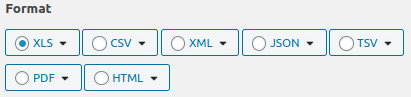
The Advanced Order Export for WooCommerce plugin provides seven powerful output formats, each with its own strengths:
- CSV (Comma-Separated Values): The universal standard for maximum compatibility.
- XLS / XLSX (Microsoft Excel): Ideal for analysis, formatting, and reports.
- XML (eXtensible Markup Language): The go-to choice for system-to-system data exchange.
- JSON (JavaScript Object Notation): The de facto standard for modern web APIs and JavaScript apps.
- TSV (Tab-Separated Values): A specialized format for databases and inventory systems.
- PDF (Portable Document Format): Perfect for sharing, printing, and permanent archiving.
- HTML (HyperText Markup Language): An incredibly easy way to create shareable web pages from your data.
Let’s dive into the specific settings for each format, so you can build the perfect export for any job.
1. CSV (Comma-Separated Values)
CSV is often the best choice. It’s a lightweight, machine-readable, plain-text format that is version-control friendly. The plugin offers several settings to overcome any formatting quirks.
Key CSV Settings
2. XLS / XLSX (Microsoft Excel)
For human analysis and deep data manipulation, there’s nothing better than an Excel file. The Advanced Order Export for WooCommerce plugin provides powerful settings to make your reports look professional.
Key XLS / XLSX Settings
3. XML (eXtensible Markup Language)
XML is a structured, hierarchical format often required for robust system-to-system integrations. It’s not for human reading but for software.
Key XML Settings
4. JSON (JavaScript Object Notation)
JSON is the lightweight, human-readable format that powers modern web APIs. If you’re sending data to a custom web app, this is your best friend.
Key JSON Settings
5. TSV (Tab-Separated Values)
TSV is a specialized cousin of CSV. Instead of a comma, it uses a tab character (\t) as its delimiter. This makes it more robust for data that may contain commas, like product descriptions.
The TSV settings are very similar to CSV. You have controls for:
6. PDF (Portable Document Format)
The PDF format is perfect for delivering a report to a client, attaching it to an email for an executive summary, or archiving it for a legal record.
Key PDF Settings
7. HTML (HyperText Markup Language)
The HTML export format is an incredibly underrated feature. It lets you instantly turn your order data into a shareable web page, perfect for internal dashboards or quick visual checks.
Key HTML Settings
Comparative Analysis: Choosing Your Champion
Here’s a quick guide to help you pick the right format for the job.
| Use Case | Recommended Format | Why? |
|---|---|---|
| Sending a report to a client | XLSX or PDF | These are professional, readable, and can be branded. |
| Sharing data with a developer | JSON or XML | These are the structured, standard languages for software. |
| One-time analysis in Excel | CSV or XLSX | CSV is fastest for export, while XLSX offers more formatting power. |
| Integrating with an ERP system | XML or JSON | These are the universal languages of system integration. |
| Feeding data to a custom script | JSON or TSV | JSON is great for modern web scripts, and TSV is good for legacy databases. |
| Printing an order summary | PDFs are designed to be printed and archived perfectly. | |
| Creating a shareable web dashboard | HTML | Generates a styled page you can share a link to, requiring no special software to view. |
| Legacy database import | TSV | Tab separators are often better for databases that struggle with commas in data. |
Best Practices for Professional Exports
From years of supporting enterprise workflows, here are my top tips:
- Always Define Your Columns: Don’t just export everything. Use the Setup Fields tab to select only the columns you need. This makes your files cleaner and your exports faster.
- Name Your Files Intelligently: Click into the Export Filename field. Use dynamic tags like
{from_date}and{to_date}to create self-documenting files, turning a genericorders.xlsxinto the much more usefulorders-from-2024-04-01-to-2024-04-30.xlsx. - Test, Then Test Again: Before you run a massive export, use the Preview button. This runs your export on a small sample of orders, letting you verify your settings and formatting without any waste.
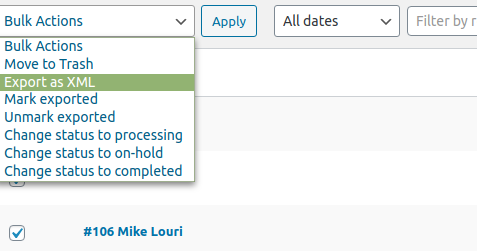
- Use the Bulk Actions Export: For a quick, one-off export of specific orders, you don’t need to create a full profile. Go to WooCommerce > Orders, check the boxes for the orders you want, open the Bulk Actions dropdown, and select “Export as CSV” or your preferred format. It’s lightning fast.
Note: You can also export the report directly from the “Orders” section. Follow next steps: